Engineering Knowledge Transfer: 8 Practices That Work
Stop losing critical knowledge when engineers leave. Eight practices to transfer expertise, raise bus factor, and cut onboarding time in half.
- Introduction
- When Knowledge Transfer Matters
- Identifying What to Transfer
- Methods for Transferring Knowledge
- Common Transfer Mistakes
- Measuring Transfer Success
- Building a Transfer Culture
- Tracking Knowledge Transfer with ContributorIQ
- Knowledge Retention Risk Assessment for Engineering Teams
- Conclusion
Introduction
Knowledge transfer is the process by which engineering teams build resilience. Without deliberate transfer, expertise concentrates in individuals, creating fragility in teams that depend on specific people being available and engaged. With effective transfer, teams can absorb departures, scale efficiently, and maintain velocity through periods of change.
Yet knowledge transfer often gets treated as an afterthought. Teams scramble through it during two-week notice periods, capturing what they can before someone walks out the door. This guide presents a more systematic approach, one that works proactively rather than just reactively.
When Knowledge Transfer Matters
During Onboarding
Every new engineer needs knowledge transfer to become productive. They must understand the codebase architecture, learn team conventions and patterns, build relationships with domain experts, and gain context for historical decisions that shaped the code they'll work with.
Poor onboarding exacts a real cost: slow ramp-up, repeated questions that interrupt others, frustrated new hires who feel lost, and senior engineers pulled from productive work to answer the same questions repeatedly. Good knowledge transfer during onboarding accelerates productivity and improves retention.
Before Known Departures
The two-week notice scramble is familiar to every engineering manager. What does this person know that we need to capture? Who should they train? What documentation needs to exist before they leave?
When knowledge transfer before departure fails, the cost compounds: orphaned systems that no one understands, bugs that take five times longer to fix because context is missing, and institutional knowledge that walks out the door permanently.
After Unexpected Departures
Sometimes departures happen without adequate preparation. Sudden resignations, terminations, and personal emergencies don't give you time to plan transfer. When this happens, teams face the expensive work of reverse engineering their own systems, sometimes engaging external consultants to help, and almost always experiencing project delays.
As Ongoing Practice
The best time for knowledge transfer is before you need it urgently. Cross-training on critical systems, deliberate ownership rotation, and documentation as ongoing practice all build resilience before crises occur. This proactive approach is far more effective than reactive scrambling.
Identifying What to Transfer
Start with quantitative analysis to identify where knowledge concentrates. Single-author files (code that only one contributor has ever touched) represent immediate vulnerabilities. Repositories with low bus factor indicate systems where few people hold all the understanding. High concentration of Degree of Authorship scores across many files suggests someone has disproportionate ownership. Orphaned files with no active expert represent knowledge that's already been lost.
Prioritize by business criticality. Revenue-generating systems should receive attention first, followed by customer-facing features, then internal tools. Not all knowledge loss carries equal risk.
Types of Knowledge
Different categories of knowledge require different transfer approaches.
System architecture (how components fit together, where data flows, what integrates with what) typically represents the highest-value knowledge to transfer. Understanding architecture lets someone reason about problems they haven't seen before.
Historical context explains why decisions were made, what alternatives were considered, and what didn't work in the past. This knowledge is difficult to document comprehensively but valuable for future decision-making.
Operational knowledge covers how to deploy, monitor, debug, and handle incidents. Engineers who might be on-call need this knowledge even if they don't modify the code frequently.
Tribal knowledge encompasses the undocumented quirks, workarounds for known bugs, and implicit assumptions that accumulate over years of working with a system. This is often the hardest knowledge to transfer because even the expert may not realize they know it.
Domain expertise combines code knowledge with business context, including understanding why the business logic exists, what edge cases matter to customers, and how regulatory requirements shape implementation.
Methods for Transferring Knowledge
Pair Programming
Pair programming works best for active learning on complex systems. Two engineers working together on real problems naturally transfer context, as the expert thinks aloud while working, explaining not just what they're doing but why.
Effective pairing for knowledge transfer means the learner should eventually drive, with the expert navigating. Verbalize thought processes throughout. Take breaks to discuss higher-level concepts that emerge from the specific work. Follow up afterward with questions while the context is fresh.
The output is shared understanding, plus potentially code changes that both people can now maintain.
Meaningful Code Reviews
Code reviews can transfer knowledge incrementally over time as part of normal workflow, but only if reviewers engage meaningfully. A review that simply approves changes without questions or discussion misses the opportunity.
Effective knowledge-sharing reviews include questions that demonstrate the reviewer is building understanding. Rotate reviewers to spread knowledge across the team rather than always routing to the same expert. Require reviewers to understand changes, not just check style compliance. Leave detailed comments explaining rationale that future readers will benefit from.
Documentation Sessions
Scheduled documentation sessions work well for capturing architecture and operational knowledge. Block dedicated time with the knowledge holder and structure the conversation around a specific goal: "Explain this system as if to someone who will maintain it after you leave."
Include diagrams such as architecture diagrams, data flow diagrams, and sequence diagrams. Visual representations often communicate what prose cannot. Capture the "why" not just the "what," because decisions without rationale lose value quickly.
After creating documentation, review it with someone unfamiliar with the system. If they can follow it, you've documented effectively. If they're confused, you've identified gaps to fill.
Shadowing Real Work
Shadowing works best for operational and on-call knowledge. The learner observes the expert handling real situations (deployments, incidents, production procedures) and asks questions throughout.
Shadow on real work, not simulations. Document observations in real-time while memory is fresh. Ask "why are you doing that?" frequently to surface implicit knowledge. Graduate from observing to doing with supervision, then to doing independently.
Recorded Walkthroughs
When live transfer isn't possible, or for creating evergreen content that benefits multiple people, recorded video walkthroughs capture knowledge asynchronously.
Keep recordings focused, limiting them to 15 to 30 minutes maximum per topic. Include screen sharing showing actual code and architecture. Organize recordings in a searchable library so future engineers can find relevant content. Update recordings when systems change significantly to prevent outdated guidance.
Common Transfer Mistakes
Documentation Alone Isn't Transfer
Writing documentation isn't the same as transferring knowledge. Someone has to read and understand the docs for transfer to occur. Comprehensive documentation sitting in a wiki that nobody references doesn't improve team resilience.
Documentation captures reference information; true understanding comes from working with systems, making changes, and debugging problems. Use documentation to supplement hands-on experience, not replace it.
One-Time Sessions Don't Stick
Knowledge doesn't transfer in a single session. Memory decay is real. A one-hour walkthrough followed by months of not touching the code leaves minimal retained understanding.
Effective transfer requires spaced repetition (multiple touchpoints over time) with graduated responsibility. Start with observing, progress to assisting, and eventually reach independent ownership. Verification through practice confirms that transfer actually occurred.
Transfer Without Verification
How do you know transfer succeeded? If the answer is "the learner said they understood," that's not verification. People often believe they understand more than they actually do.
Verification requires demonstration. Create opportunities for the learner to work independently with support available but not leading. Transfer is complete when the learner can handle real work without constant guidance.
Waiting Until Departure
Two weeks is rarely enough for meaningful knowledge transfer, especially for complex systems. When transfer only happens during notice periods, handoffs are inevitably incomplete.
The solution is continuous transfer, building knowledge sharing into regular workflow through reviews, pairing, and rotation. When departure happens, it should be a non-event because knowledge is already distributed.
Measuring Transfer Success
Leading indicators signal that transfer is working before you can measure outcomes: code review participation from backup owners, commits in new areas by learning contributors, decreasing frequency of questions to the original expert, and improving documentation coverage.
Lagging indicators measure results after transfer: improving bus factor, reduced single-author file percentage, new contributors reaching Peak lifecycle stage faster, and fewer escalations requiring original experts.
Business indicators show operational impact: stable or improving incident response times, vacation coverage without service degradation, decreasing onboarding time for new hires, and maintained project velocity through departures.
Building a Transfer Culture
Knowledge transfer shouldn't be an occasional project but an embedded practice. Include knowledge sharing in sprint planning rather than treating it as overhead. Make mentorship part of job expectations for senior engineers. Allocate explicit time for transfer activities. Recognize knowledge sharing in performance reviews.
Create incentives that support transfer. Don't reward knowledge hoarding, even unintentional hoarding that comes from being helpful. Promote engineers who build capable teams, not just individual contributors. Celebrate when systems become maintainable by multiple people. Make "single point of failure" a negative signal, not a badge of expertise.
Remove barriers to transfer. Allocate time, because transfer takes effort away from feature work, and that trade-off needs organizational support. Provide tools for screen recording, documentation platforms, and pairing. Reduce friction so documentation is easy to create and find. Support learners by making question-asking encouraged rather than penalized.
Tracking Knowledge Transfer with ContributorIQ
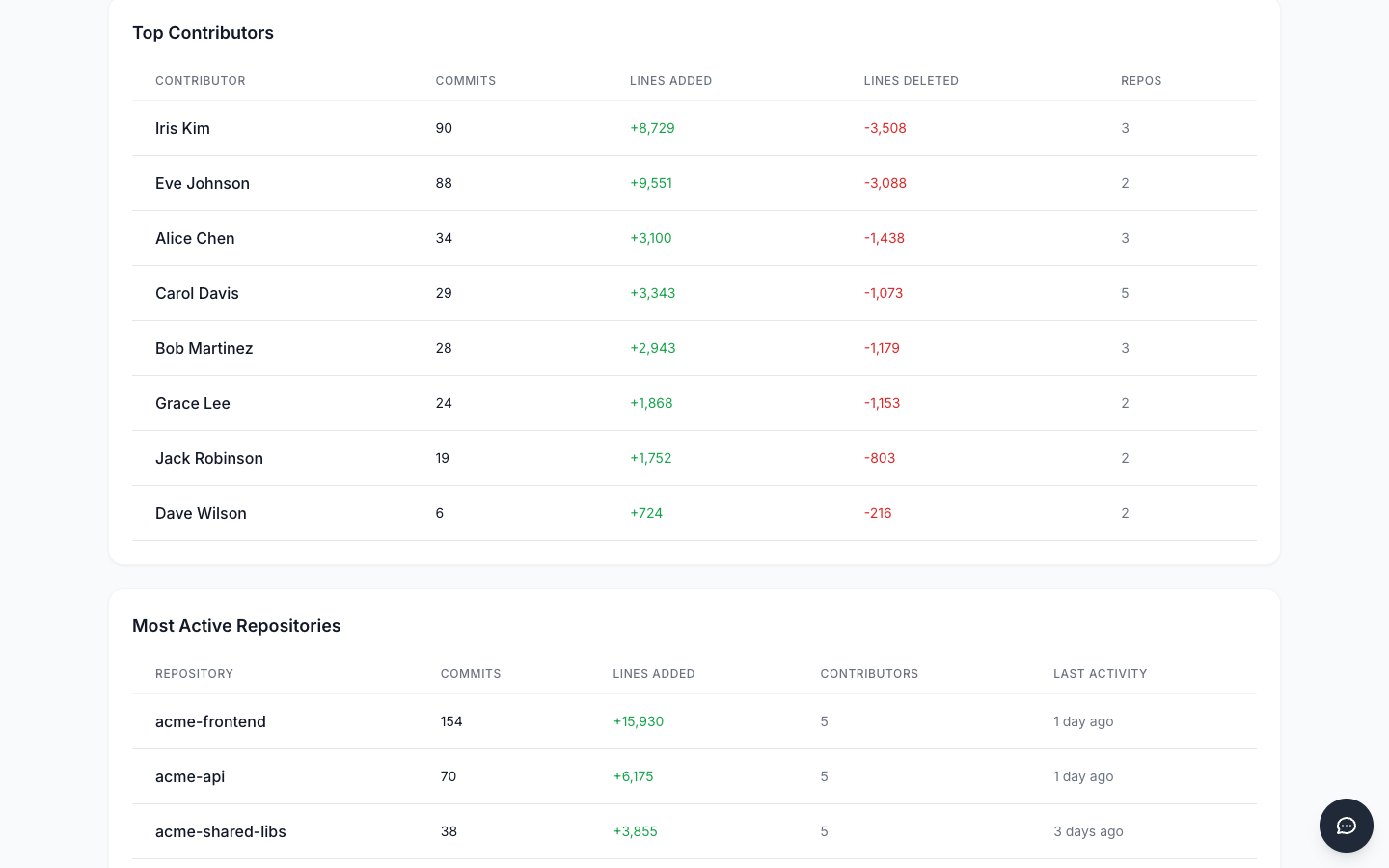
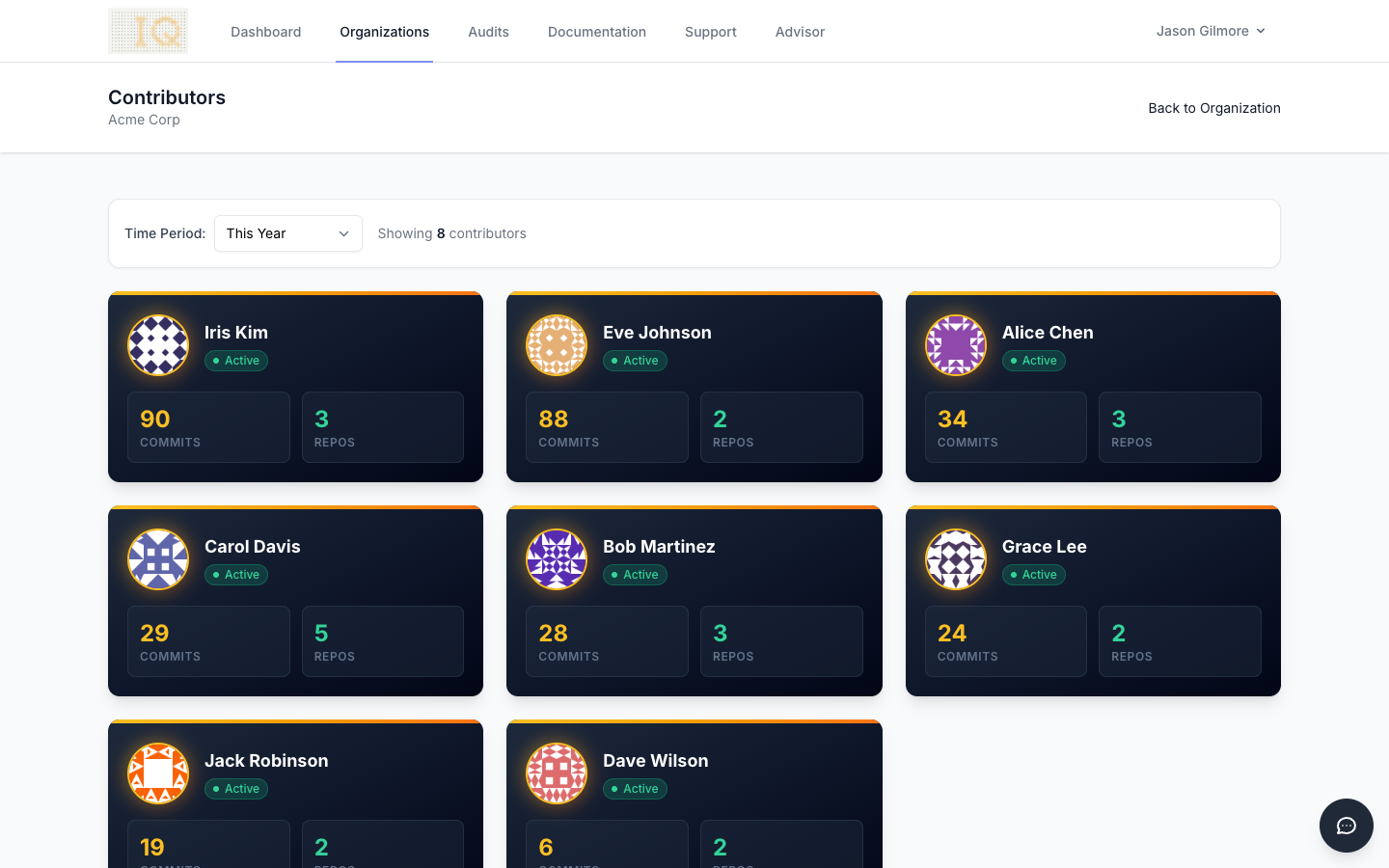
Identifying where knowledge concentrates is the first step in any transfer initiative, and ContributorIQ automates this discovery. The Top Contributors view ranks your engineers by authorship footprint and highlights where knowledge is unevenly distributed. When a small number of contributors dominate ownership across many repositories, you can see it immediately and prioritize cross-training efforts on the most concentrated areas. This view also shows each contributor's lifecycle stage, so you can identify whether your top knowledge holders are actively engaged or at risk of departing.
The Contributor Lifecycle Overview gives you a team-level view of engagement patterns over time. By tracking how many contributors are in each lifecycle stage (Ramping Up, Peak, Winding Down, or Departed), you can measure whether your knowledge transfer efforts are succeeding. A healthy transfer culture shows new contributors reaching Peak stage faster, fewer contributors Winding Down without successors, and stable bus factor metrics even as team composition changes. If your Winding Down or Departed counts are climbing while Peak counts stagnate, it signals that knowledge is leaving faster than it is being shared.
ContributorIQ provides the quantitative foundation for continuous knowledge transfer. Rather than waiting for a departure to trigger a scramble, your team can monitor ownership concentration, track whether cross-training is reducing single-author file percentages, and verify that new contributors are building meaningful authorship in critical areas.
Knowledge Retention Risk Assessment for Engineering Teams
A knowledge retention risk assessment identifies where your engineering team is most vulnerable to knowledge loss and prioritizes transfer efforts accordingly. This is especially critical during M&A due diligence, organizational restructuring, or when key engineers signal potential departure.
The assessment combines several quantitative signals. Bus factor by system identifies which codebases would stall if specific individuals left. Any critical system with a bus factor of 1 represents immediate retention risk. Contributor lifecycle stage reveals whether knowledge holders are engaged (Peak), building expertise (Ramping Up), or showing declining activity (Winding Down) that often precedes departure. Single-author file percentage measures how much code has been touched by only one person, representing knowledge that's one resignation away from becoming orphaned.
To conduct a retention risk assessment, start by mapping critical systems to their primary knowledge holders. For each knowledge holder, assess their lifecycle stage, tenure, and retention factors (vesting schedules, role satisfaction, market alternatives). Cross-reference this with the business impact of each system they maintain. The result is a prioritized list of retention risks ranked by both likelihood and potential damage.
The output should drive concrete action: retention conversations with high-risk knowledge holders, immediate cross-training on the most concentrated systems, documentation sprints for areas where knowledge exists only in people's heads, and updates to succession plans. Reassess quarterly, because retention risk is dynamic: team composition, market conditions, and individual engagement all shift over time.
Conclusion
Systematic knowledge transfer builds organizational resilience. The approach is straightforward: identify where knowledge concentrates using data, prioritize based on business criticality, select appropriate methods for different knowledge types, verify that transfer succeeded through practice, and maintain transfer as an ongoing habit rather than a departure-triggered scramble.
The investment pays off when departures happen. With effective transfer, a resignation becomes a transition to manage rather than a crisis to survive. The knowledge that mattered was already shared, and the team continues without disruption.