The 5 Contributor Lifecycle Stages: Early Warning Indicators for Retention and Succession
Learn to identify which engineers are ramping up, at peak performance, or showing signs of disengagement. Use lifecycle stages for retention conversations and succession planning.
- Introduction
- The Five Stages Explained
- Using Lifecycle Data Effectively
- Responding to Warning Signals
- Limitations to Keep in Mind
- How ContributorIQ Tracks Contributor Lifecycles
- Conclusion
Introduction
Not every engineer on your team is in the same state of engagement. Some are new and still learning the codebase, absorbing context and building relationships. Others are at their productive peak, driving significant output with deep understanding. And some, critically, are showing signs of disengagement, their contribution patterns suggesting they might be preparing to move on.
Understanding these lifecycle stages enables proactive management. Instead of being surprised by resignation letters, you can identify changes in engagement early enough to intervene. You might have retention conversations, begin knowledge transfer, or adjust team structures before the situation becomes urgent.
The Five Stages Explained
Peak Contributors
Peak contributors are your reliable performers, engineers who have been around long enough to build context and are now contributing consistently and productively. Their output is stable or growing, they engage broadly across the codebase, and their work patterns are predictable.
These are the people who form the knowledge backbone of your projects. They're candidates for leadership, mentorship, or expanded scope. While no one's departure risk is zero, Peak contributors represent your lowest immediate concern from a retention perspective.
The typical profile shows tenure beyond three months, recent activity matching or exceeding their historical baseline, and consistent contribution patterns week over week.
Ramping Up Contributors
Ramping Up contributors are new to the team or the codebase, still building the context they need to be fully productive. Their commit velocity tends to be lower than established contributors, they touch fewer files and repositories, and they may show higher churn ratios as they learn through iteration.
This stage is completely normal for new hires and shouldn't trigger concern. These contributors need mentorship and clear onboarding paths. Their bus factor contribution remains limited until they reach Peak, but that's expected, since you're investing now for future productivity.
The key metric to watch is how long people stay in this stage. If contributors take significantly longer to reach Peak than expected, that might indicate friction in your onboarding process.
Winding Down Contributors
Winding Down is the most important stage to detect because it often precedes departure. These contributors show declining activity compared to their historical baseline, and their recent work is notably less than their prior patterns suggested.
Several things might explain Winding Down patterns. The engineer might be transitioning to other projects internally. They might be losing engagement with their current work due to boredom or frustration. They might be interviewing for new positions and mentally checking out. Or personal circumstances might be reducing their availability temporarily.
The key is recognizing the pattern and having a conversation rather than assuming the worst. Some Winding Down patterns reverse with intervention; others represent genuine departure risk that should trigger knowledge transfer planning.
When a key contributor shifts to Winding Down, the urgency depends on what they own. If they're the sole expert on a critical system, that's an immediate conversation. If they have backup coverage, you have more time to understand the cause.
Dormant Contributors
Dormant contributors haven't committed in a significant period (typically 90 to 365 days) but haven't fully departed. They might still be employed but focused on different work, on extended leave, or in a role that doesn't involve active coding.
For practical purposes, Dormant contributors shouldn't factor into your active bus factor calculations. Their knowledge is still potentially accessible if needed, but they're not actively maintaining anything.
The main action with Dormant contributors is understanding why they're dormant. If it's intentional (role change, different project), that's fine. If it's unclear, it's worth investigating whether there's a problem.
Departed Contributors
Departed contributors haven't committed in over a year and, for practical purposes, are unavailable for questions. Whatever knowledge they held is effectively lost unless it was documented or transferred before they became inactive.
Files that Departed contributors owned should be considered at risk. Identify successors and ensure any orphaned areas have someone assigned to build understanding. The transition from Dormant to Departed is your deadline for knowledge preservation.
Using Lifecycle Data Effectively
Detecting Early Warning Signs
The most valuable insight from lifecycle tracking is detecting Peak to Winding Down transitions in key contributors. When someone who has been consistently productive starts showing declining patterns, that's a signal worth investigating.
Before assuming someone is leaving, verify the signal. Is this a temporary dip from vacation, a different project, or personal circumstances? Or is it a sustained pattern? A single quiet week doesn't mean anything; several weeks of declining activity relative to historical baseline suggests something has changed.
If the pattern is sustained, have a direct conversation. Don't accuse; express concern. "I noticed your activity has decreased recently. Is everything okay? Are there blockers I can help with?" The goal is understanding, not confrontation.
Common causes of Winding Down include boredom with current work (they need new challenges), feeling undervalued (a recognition issue), external job offers (a competitive situation), burnout (a workload issue), or team dynamics problems. Each cause suggests different interventions.
Planning Succession Proactively
Lifecycle data enables succession planning before you need it urgently. Pair Ramping Up contributors with Peak contributors to accelerate context building and establish backup knowledge. Assign explicit successors when Winding Down contributors own critical files. Start documentation sprints before departure rather than scrambling during notice periods.
Track ramp-up time to identify onboarding friction. How long does the average contributor take to progress from Ramping Up to Peak? If that time is increasing, or if certain teams have notably longer ramp periods, investigate what's creating friction for new engineers.
Evaluating Acquisition Targets
In M&A due diligence, lifecycle distribution reveals team stability. A healthy target has most contributors at Peak with a reasonable Ramping Up population indicating growth.
Red flags include high Departed count relative to total contributors (suggesting a turnover problem), multiple key contributors classified as Winding Down (representing immediate retention risk post-close), very few Peak contributors (indicating instability), and repositories where all Peak contributors are simultaneously Winding Down (requiring urgent attention).
Responding to Warning Signals
When you identify a Winding Down pattern in a key contributor, respond systematically.
First, verify whether the signal is real. Check for alternative explanations such as different projects, personal circumstances, or seasonal patterns. A dip in December might reflect holiday schedules, not disengagement.
Second, have the conversation early. "I noticed your contributions have decreased. How are you feeling about your current work? Are there blockers or frustrations I can help with?" This shows you're paying attention and opens the door for honest discussion.
Third, identify the root cause if possible. Understanding why someone is disengaging lets you address fixable issues. New challenges can remedy boredom. Recognition can address feeling undervalued. Workload adjustments can help with burnout. But you can't fix what you don't understand.
Fourth, take appropriate action based on what you learn. If the cause is fixable, fix it with new projects, recognition, or workload changes. If departure seems likely, begin knowledge transfer and successor identification while the contributor is still available and potentially motivated to ensure smooth transition.
When All Experts Are Winding Down
A special case deserving urgent attention: when all Peak contributors on a critical system show Winding Down patterns simultaneously. This is an organizational emergency.
This situation means your knowledge coverage is about to disappear, with no one ramping up to replace it. Consider retention incentives for key individuals, begin cross-training immediately regardless of the underlying cause, prioritize documentation, and prepare for worst-case scenarios where multiple people leave at once.
Limitations to Keep in Mind
Lifecycle classification is per-repository, not per-person. A contributor might be Peak on the main application, Dormant on a legacy tool, and Ramping Up on a new microservice all at the same time. Aggregate across repositories for organization-level views, but use repository-specific classification for bus factor calculations.
External factors can affect classification. Maternity or paternity leave, sabbaticals, and internal transfers all create Dormant patterns without indicating departure risk. Project completion naturally shows declining activity as work winds down. Use lifecycle stage as a signal for conversation, not as a verdict.
Activity doesn't equal value. A contributor Winding Down in commit frequency might be moving to architecture work (fewer commits, higher impact), mentoring juniors (their influence shows up in others' commits), or doing valuable non-code work like documentation and coordination. Combine quantitative signals with qualitative understanding.
How ContributorIQ Tracks Contributor Lifecycles
Classifying contributors by lifecycle stage manually would require pulling commit histories, calculating activity baselines, comparing recent output to historical patterns, and repeating that analysis for every contributor across every repository. ContributorIQ performs this classification automatically. Each contributor is assigned a lifecycle stage (Peak, Ramping Up, Winding Down, Dormant, or Departed) based on their activity patterns, and the classifications update continuously as new data arrives.
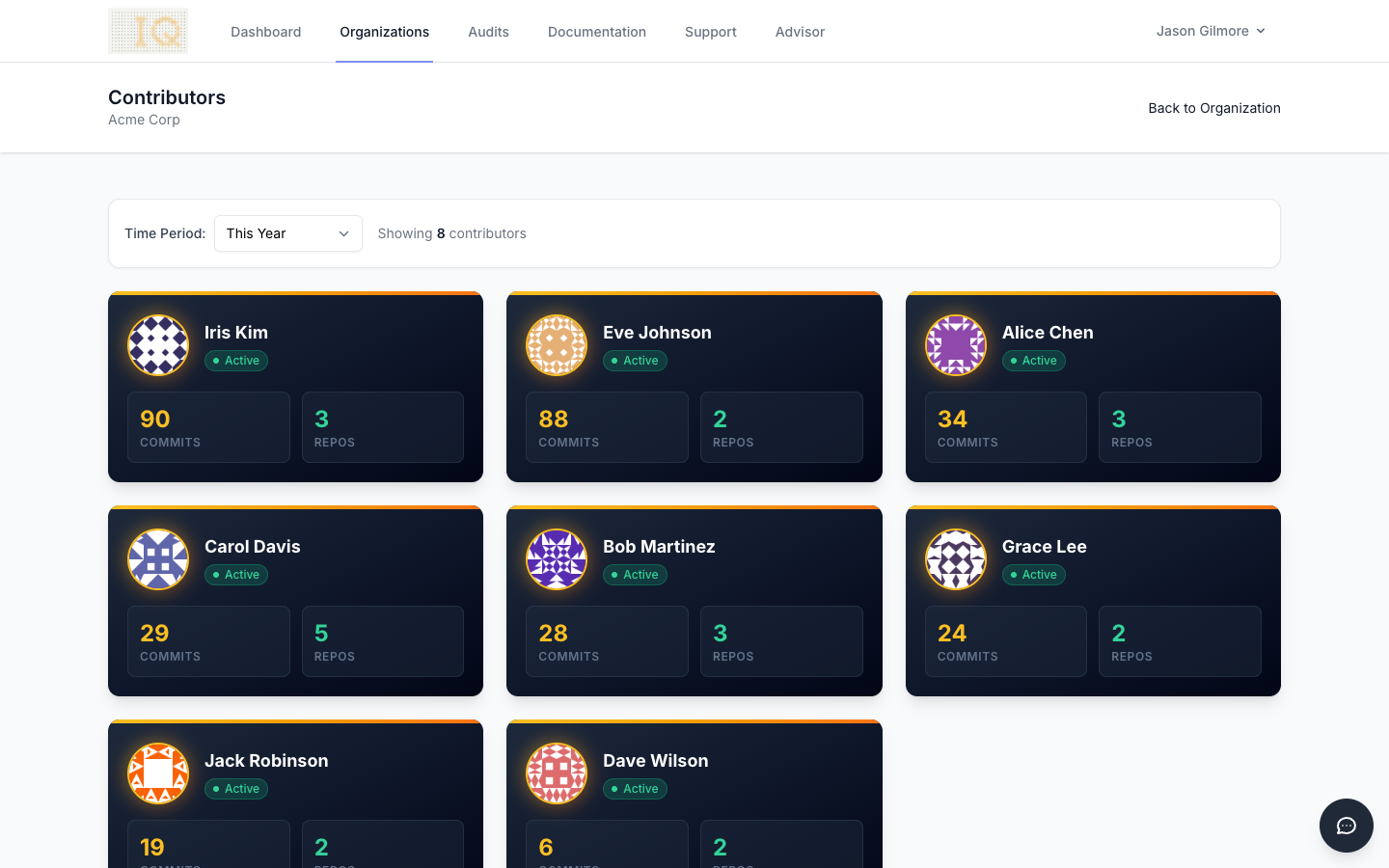
The contributor lifecycle overview provides a visual breakdown of your entire organization's engagement distribution. You can immediately see what percentage of contributors are at Peak performance, how many are currently ramping up, and, most critically, which contributors are showing Winding Down patterns that may warrant a retention conversation. The view also highlights Dormant and Departed contributors whose knowledge may need to be recovered or redistributed.
By combining lifecycle classification with bus factor and Degree of Authorship data, ContributorIQ can flag the scenarios that matter most: a sole expert on a critical system shifting from Peak to Winding Down, or multiple key contributors becoming Dormant simultaneously. These compound risk signals are difficult to detect without automated analysis, but they represent exactly the situations where early intervention can prevent organizational emergencies.
Conclusion
Contributor lifecycle stages transform reactive management into proactive intervention. By automatically classifying contributors based on activity patterns, you can detect disengagement early while there's still time to act, prioritize knowledge transfer before departures create crises, identify onboarding friction through ramp-up analysis, and assess acquisition targets for team stability.
The key is using lifecycle data as an early warning system. When you see patterns suggesting change, investigate promptly. When you identify risk, act while you have time. The goal is ensuring that departures, which are inevitable, become manageable transitions rather than organizational emergencies.