Introducing AI Advisor Reports: Tailored Engineering Insights for Every Stakeholder
ContributorIQ's new AI Advisor feature generates role-specific reports for engineering managers, executives, and M&A buyers. Each report analyzes your team's metrics and delivers actionable recommendations.
- Introduction
- How It Works
- Three Audience Perspectives
- Time Period Filtering
- Built on Real Data, Not Generic Templates
- Getting Started
- What's Next
Introduction
Engineering metrics are only valuable when they lead to action. A bus factor of 1, a Gini coefficient of 0.72, a churn ratio of 0.45: these numbers tell a story, but the story changes depending on who's reading it. An engineering manager needs to know which repositories need cross-training. An executive needs to understand how team health affects delivery timelines. An M&A buyer needs to quantify key person risk before making an offer.
Until now, translating ContributorIQ's metrics into role-specific recommendations required manual interpretation. Today, we're introducing AI Advisor Reports, a feature that analyzes your organization's contributor data and generates tailored advisory reports for three distinct audiences.
How It Works
The Advisor sits on top of ContributorIQ's existing analytics engine. After running an audit on your GitHub organization, navigate to any audit report and select the Advisor tab. The system feeds your organization's metrics, contributor data, and repository statistics into a specialized AI model that generates a written advisory report.
Each report is generated fresh from your actual data. There are no templates filled with generic advice. The AI examines your specific bus factor scores, contributor lifecycle stages, knowledge distribution patterns, code churn ratios, and work patterns to produce recommendations that reflect your team's reality.
Reports are cached intelligently: they only regenerate when the underlying prompt template changes or when you explicitly request a refresh. This means you can revisit a report without waiting for regeneration each time, while still having access to updated analysis when your data changes.
Three Audience Perspectives
The same engineering data tells different stories depending on the audience. ContributorIQ provides three tailored perspectives, each emphasizing the metrics and recommendations most relevant to that role.
Engineering Manager
The Engineering Manager report is built for the people closest to the code and the team. It provides technical depth on bus factor risks, code churn patterns, and contributor velocity, then translates those findings into specific actions.
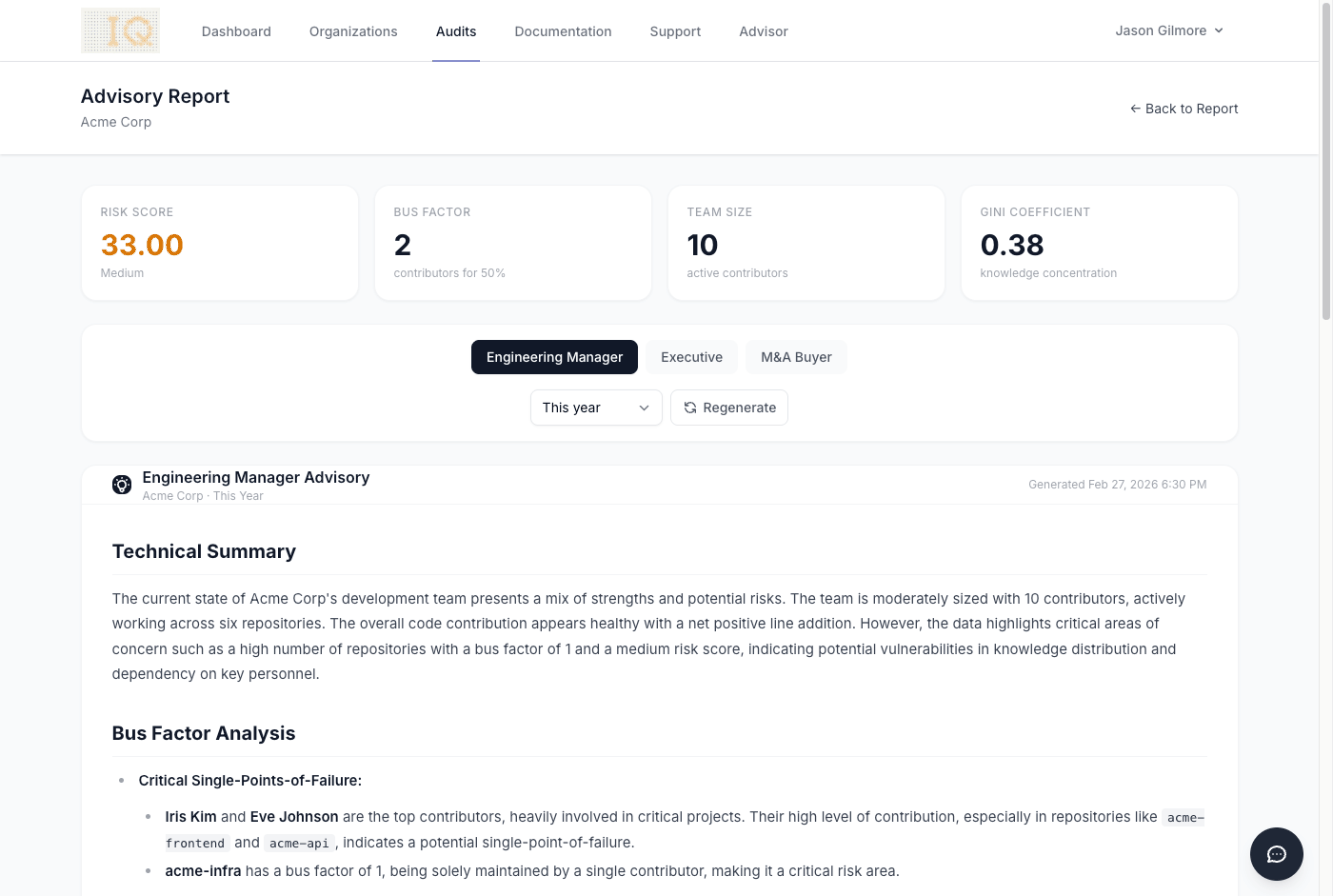
A typical Engineering Manager report covers:
- Bus Factor Analysis with specific call-outs for repositories at risk and which contributors represent single points of failure
- Code Churn Assessment examining the balance between new code and refactoring, with guidance on whether current ratios indicate healthy maintenance or potential instability
- Knowledge Distribution evaluation using Gini coefficients and contributor lifecycle stages to identify where cross-training should be prioritized
- Work Pattern Insights highlighting business-hours versus off-hours activity, weekend work trends, and what those patterns suggest about team sustainability
- Actionable Recommendations ranked by priority, with specific steps like "pair Eve Johnson with a second contributor on acme-frontend to reduce bus factor from 1"
Executive
The Executive report distills the same data into business-impact language. Instead of Gini coefficients and churn ratios, it focuses on organizational resilience, delivery risk, and team health trends that affect strategic decisions.
Executives see the metrics that matter at the portfolio level: overall risk scores, team retention signals, and whether the engineering organization can sustain its current pace. Recommendations focus on resource allocation, hiring priorities, and structural changes rather than individual code reviews or pairing sessions.
M&A Buyer
The M&A Buyer report is designed for due diligence scenarios. It quantifies the risks that traditional code audits miss: key person dependencies, knowledge concentration, contributor engagement trajectories, and the operational impact of potential departures.
This perspective is particularly valuable during acquisition evaluations, where the question isn't just "is the code good?" but "will the team that built it stay, and what happens if they don't?" The report highlights areas where post-acquisition integration requires careful planning and where team composition creates or mitigates deal risk.
Time Period Filtering
Every Advisor report supports time period filtering. Analyze your team's patterns across different windows:
- All time for a comprehensive historical view
- This year, this quarter, or this month for recent trends
- Last 30 or 90 days for rolling-window analysis
Comparing reports across time periods reveals trajectory. A bus factor that was 3 last quarter but dropped to 1 this month tells a more urgent story than a bus factor that has been stable at 2 for a year.
Built on Real Data, Not Generic Templates
Every recommendation in an Advisor report traces back to your organization's actual metrics. When the report says a repository has critical bus factor risk, it names the repository and the contributor. When it suggests cross-training, it identifies the specific people and systems involved.
This specificity matters because generic advice ("improve documentation," "reduce key person risk") is easy to produce and hard to act on. Targeted recommendations ("pair Iris Kim with a second contributor on acme-frontend, where she currently accounts for 45% of commits") give managers something they can put on next sprint's agenda.
Getting Started
AI Advisor Reports are available now for all ContributorIQ accounts. To generate your first report:
- Navigate to any completed audit report
- Click the Advisor tab in the navigation
- Select your audience type (Engineering Manager, Executive, or M&A Buyer)
- Choose a time period for analysis
The report generates in seconds and is cached for quick access on return visits. Click Regenerate at any time to produce a fresh analysis with the latest data.
What's Next
The Advisor is the foundation for a broader set of AI-powered features we're building into ContributorIQ. Future releases will include automated trend detection across audit periods, proactive alerts when risk indicators cross thresholds, and integration with team communication tools for scheduled report delivery.
We'd love to hear how you're using the Advisor reports and what additional perspectives would be valuable for your team. Reach out through the support chat or at [email protected].