What Is Bus Factor? Definition, Risks & Calculation
Bus factor is the number of engineers whose departure would stall a project. Definition, what a bus factor of 1 means, and how to calculate it with DOA.
- What Is Bus Factor? A Clear Definition
- Bus Factor Meaning in Software Engineering
- What Does a Bus Factor of 1 Mean?
- How Bus Factor Is Calculated
- Understanding Risk Levels
- Why Different Stakeholders Care About Bus Factor
- Reducing Bus Factor Risk
- Common Anti-Patterns to Avoid
- Measuring Bus Factor with ContributorIQ
- Frequently Asked Questions
- Conclusion
What Is Bus Factor? A Clear Definition
Bus factor is the minimum number of team members who would need to leave before a project stalls due to knowledge loss. The term comes from a morbid thought experiment: how many people on the team could get hit by a bus before the project can no longer continue? It is also sometimes called "truck factor" or, more optimistically, "lottery factor" (as in: what if they won the lottery and quit?).
In software engineering, bus factor is a widely used metric for measuring knowledge concentration risk. A project with a bus factor of 1 has critical risk, because a single person's departure could bring development to a halt. A project with a bus factor of 5 or higher has well-distributed knowledge that can absorb team changes without disruption.
Bus factor matters because it makes an invisible organizational risk visible. Most engineering leaders intuitively know they have key person dependencies, but bus factor puts a number on exactly how exposed each system is.
Bus Factor Meaning in Software Engineering
In the context of software development, bus factor measures something fundamentally different from team size. A team of ten developers might still have a bus factor of 1 if only one person truly understands the critical billing system. Conversely, a small team of three might have a healthy bus factor if they have deliberately shared knowledge across all their systems.
The distinction matters because adding headcount does not automatically improve bus factor. You could hire five new engineers tomorrow and still be vulnerable if they are all working on new features while your critical legacy systems remain understood by a single person. Bus factor measures knowledge concentration, not staffing levels.
This is why simple metrics like commit counts can be misleading. A developer might have hundreds of commits, but if they are all small documentation updates while someone else made a handful of commits that established the entire architecture, the commit counts do not reflect true ownership. Real understanding comes from creating and maintaining code over time, not just touching files.
What Does a Bus Factor of 1 Mean?
A bus factor of 1 is the most dangerous score a project can have. It means exactly one person holds the critical knowledge needed to maintain a system. If that person leaves the company, goes on extended leave, gets sick, or even just takes a two-week vacation, the team may be unable to fix bugs, ship features, or respond to incidents in that part of the codebase.
Here is what a bus factor of 1 looks like in practice:
- Only one person reviews PRs for a particular service or module, because nobody else understands it well enough
- Incident response depends on one person. When that system breaks at 2 AM, the team pages the same engineer every time
- Onboarding stalls. New engineers avoid the codebase because there is no documentation and the sole expert is too busy to pair
- Velocity drops during PTO. Sprint planning works around one person's vacation schedule
A bus factor of 1 does not mean the project will fail tomorrow. It means you are one resignation, one illness, or one competing job offer away from a serious problem. In the context of mergers and acquisitions, a bus factor of 1 on revenue-critical systems is a red flag that should factor into valuation and retention planning.
The related term "bus factor of 0" is sometimes used informally to describe a project where the sole knowledgeable contributor has already left. At that point the system is effectively orphaned.
How Bus Factor Is Calculated
The most basic approach counts how many contributors you need to account for 50% or more of the work. You list everyone who has committed to a repository, sort them by how much they have contributed, and count how many people you need before you have covered half the codebase. That count is your bus factor.
This simple method has a significant limitation: it treats all commits equally. A commit that fixes a typo and a commit that implements a core feature both count as one commit. This can produce misleading results when contribution styles vary widely across your team.
A more sophisticated approach uses what is called Degree of Authorship (DOA), based on academic research by Fritz and colleagues. DOA considers three factors when calculating someone's ownership of a file: whether they originally created it (which typically indicates foundational understanding), how many times they have modified it (ongoing engagement), and how much the file has changed since their last edit (knowledge decay). These factors combine into a normalized score between 0 and 1.
Contributors with a DOA above 0.75 are considered "authors" of that file, meaning they have sufficient understanding to maintain it independently. The DOA-based bus factor then calculates the minimum number of these authors needed to cover more than half of all files in the repository. This produces more accurate results because it accounts for the significance of different types of contributions and recognizes that knowledge fades when you are not actively working with code.
Understanding Risk Levels
| Bus Factor | Risk Level | What It Means |
|---|---|---|
| 1 | Critical | A single departure stalls the project |
| 2 | High | Losing either expert drops you to critical |
| 3-4 | Medium | Reasonable coverage, room to improve |
| 5+ | Healthy | Team absorbs departures without disruption |
A bus factor of 2 is still high risk. While you have some redundancy, losing either person severely impacts the other. If one of the two experts leaves, you are immediately back at bus factor 1, and the remaining person now carries even more burden.
Bus factors of 3 or 4 represent medium risk, with reasonable coverage and room for improvement. You can absorb a departure without crisis, but you are not comfortably resilient either.
A bus factor of 5 or higher indicates well-distributed knowledge. The team can handle departures, vacations, and sick days without significant impact on velocity or capability. This is where healthy teams should aim to be for critical systems.
Why Different Stakeholders Care About Bus Factor
For engineering managers, bus factor directly affects daily operations. Can you maintain normal velocity when someone takes vacation? Who can step up if a key contributor gets promoted into a different role? Are your sprint assignments inadvertently creating new single points of failure?
For CTOs and VPs of Engineering, bus factor becomes an organizational risk metric. Low bus factor across critical systems indicates that scaling will be difficult, because new team members cannot effectively contribute to areas they cannot access. It also often signals documentation debt and suggests the team would struggle to onboard engineers effectively.
In the context of mergers and acquisitions, bus factor takes on financial significance. Acquiring a company with a bus factor of 1 on its core product means your investment depends on specific individuals staying post-acquisition. This risk should factor into valuation discussions and retention package planning.
Reducing Bus Factor Risk
Improving bus factor requires deliberate effort. The natural tendency is for work to flow toward whoever already knows the most, which reinforces rather than distributes expertise. Breaking this pattern requires intentional intervention.
Start by identifying your single-author files, the code that only one person has ever modified. These are your most immediate vulnerabilities. Implement pair programming on critical systems, especially during complex changes. Pairing naturally distributes knowledge because two people now understand the change instead of one.
Code reviews can be powerful knowledge transfer tools, but only if reviewers engage meaningfully. A review that simply approves changes without asking questions or building understanding is a missed opportunity. Consider requiring that someone other than the author be able to explain what a change does before it merges.
Documentation helps, but it is not a substitute for actual understanding. The most useful documentation captures the "why" behind decisions: the alternatives considered, the constraints that shaped the design, the problems that previous approaches encountered. This context helps future maintainers make good decisions even when facing situations the original author did not anticipate.
For longer-term improvement, consider deliberately rotating ownership. Periodically assign different developers to maintain systems, even if it temporarily slows things down. The short-term efficiency loss pays dividends in resilience. Track bus factor metrics quarterly and treat improvement as a genuine team objective, not just something to worry about when departures happen.
Common Anti-Patterns to Avoid
The "hero developer" pattern is perhaps the most common path to low bus factor. One person becomes the expert on everything, the one who always fixes critical issues, the one everyone asks. This person is often highly productive individually, but they create organizational fragility. If they leave, or simply go on vacation, progress stops.
Another trap is believing documentation substitutes for distributed knowledge. Comprehensive docs sitting in a wiki that nobody reads do not improve bus factor. Real understanding comes from working with code, making changes, debugging problems. Documentation supplements hands-on experience; it does not replace it.
Code reviews can become checkboxes rather than knowledge transfer opportunities. When reviewers rubber-stamp changes without building understanding, you get the appearance of oversight without the benefit of distributed knowledge. Good reviews should leave the reviewer able to work with that code themselves.
Measuring Bus Factor with ContributorIQ
Calculating bus factor manually across dozens of repositories is tedious and error-prone. ContributorIQ automates the entire process by connecting to your GitHub organization, analyzing commit history using Degree of Authorship, and producing bus factor scores for every repository in minutes. Rather than relying on rough estimates or gut feelings about knowledge concentration, you get precise, data-driven measurements that update as your codebase evolves.
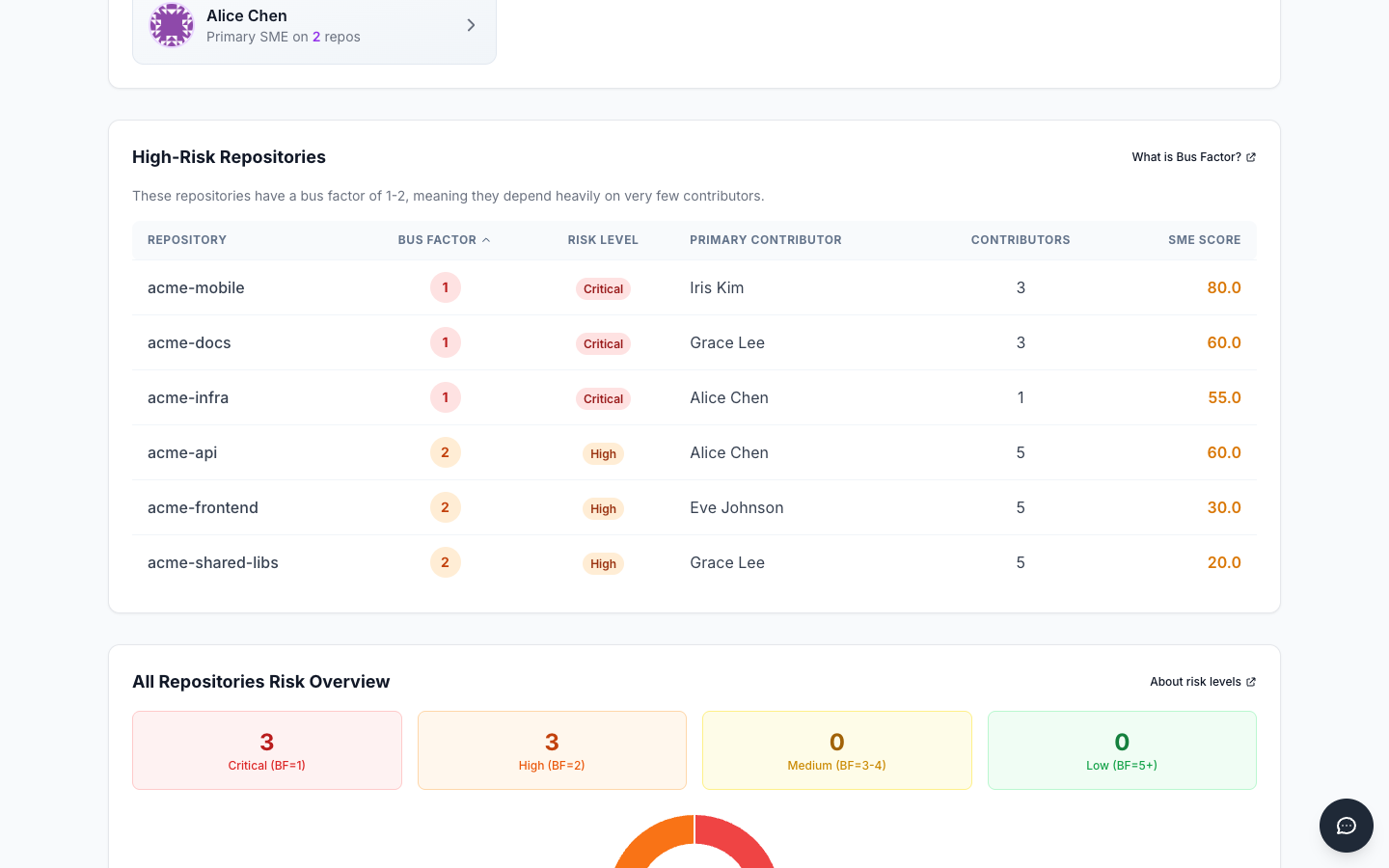
The bus factor distribution view provides a clear picture of where risk concentrates across your organization. Each repository is scored and color-coded, making it easy to spot critical systems with a bus factor of 1 and prioritize knowledge-sharing efforts where they matter most.
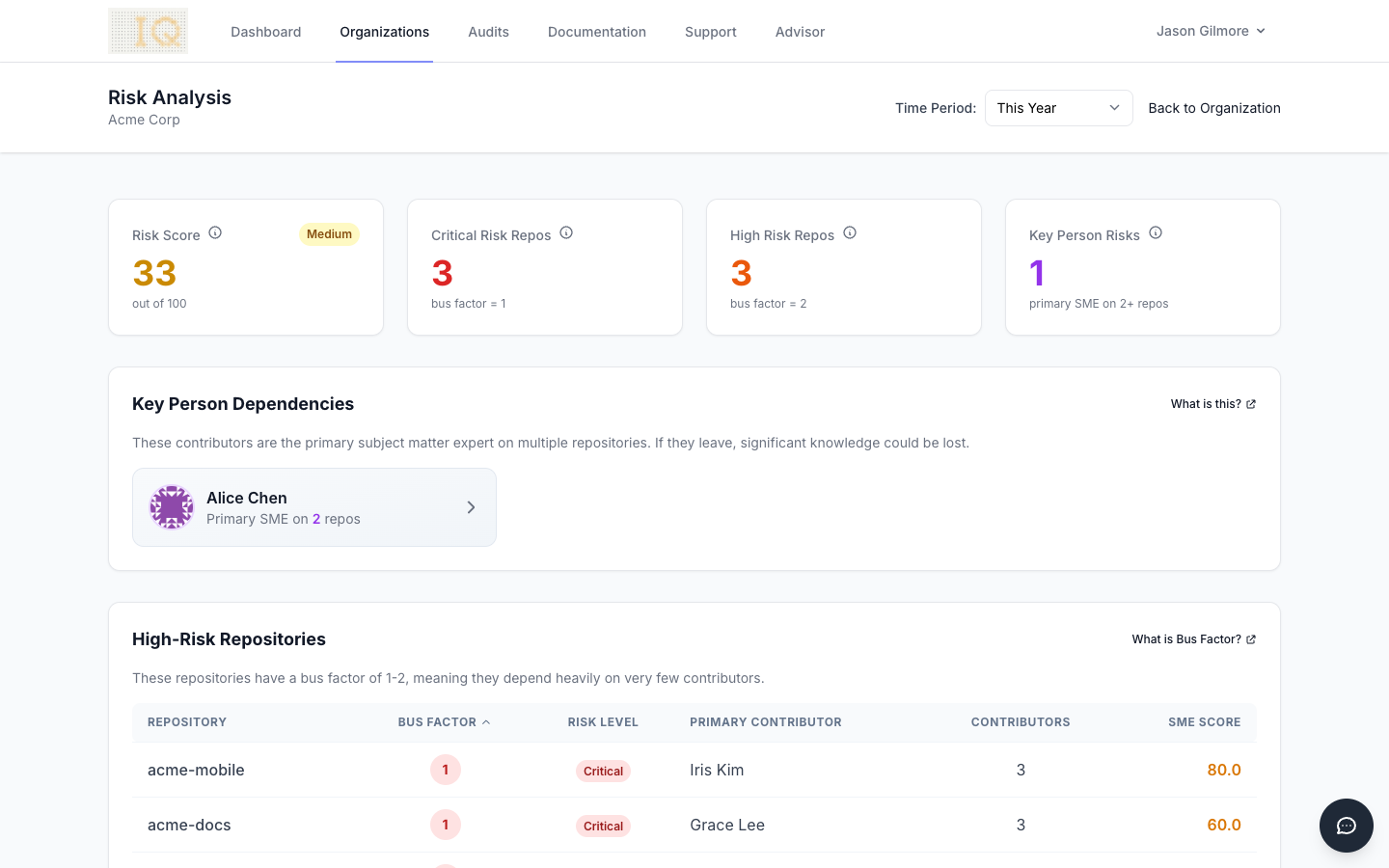
ContributorIQ also rolls these repository-level findings into an organization-wide risk dashboard. This gives engineering leaders and due diligence teams a single view of overall knowledge concentration, orphaned file percentages, and single-author risk. Instead of assembling spreadsheets from multiple data sources, you can assess your organization's resilience posture in one place and track improvements over time.
Frequently Asked Questions
What is bus factor in simple terms?
Bus factor is the number of people on a team who could disappear before a project grinds to a halt. If your bus factor is 1, a single departure puts the project at risk. If it is 5, the team has enough shared knowledge to keep going even if several people leave at once.
What does bus factor of 1 mean?
A bus factor of 1 means only one person has the knowledge needed to maintain a critical system. If that person leaves, gets sick, or is unavailable for any reason, the team cannot effectively maintain or develop that part of the codebase. It is the highest-risk score and should be treated as an urgent priority for knowledge distribution.
How do you reduce bus factor?
The most effective strategies are pair programming on critical systems, meaningful code reviews where reviewers build real understanding, deliberate rotation of ownership across team members, and maintaining decision-focused documentation. The key insight is that reducing bus factor requires changing how work flows through the team, not just adding more people. Read our detailed guide on bus factor signals and warning signs for practical steps.
Is bus factor the same as truck factor?
Yes. Bus factor, truck factor, and lottery factor all describe the same concept. "Lottery factor" reframes the scenario optimistically: how many team members could win the lottery and resign before the project stalls? Regardless of the name, the metric measures the same thing: knowledge concentration risk.
Conclusion
Bus factor serves as a leading indicator of organizational health. A low bus factor does not mean disaster is imminent, but it does mean you are one resignation away from problems. The metric makes an invisible risk visible.
The encouraging news is that bus factor is improvable. With deliberate effort around code reviews, pair programming, and knowledge sharing, teams can build resilience without sacrificing velocity. The key is treating knowledge distribution as an ongoing practice rather than something to scramble through when someone gives notice.
Bus factor works best as one signal among many. Combine it with lifecycle analysis to understand whether key contributors are engaged or disengaging, knowledge distribution metrics to see where expertise concentrates, and qualitative understanding from your team leads to get the complete picture of organizational health.